
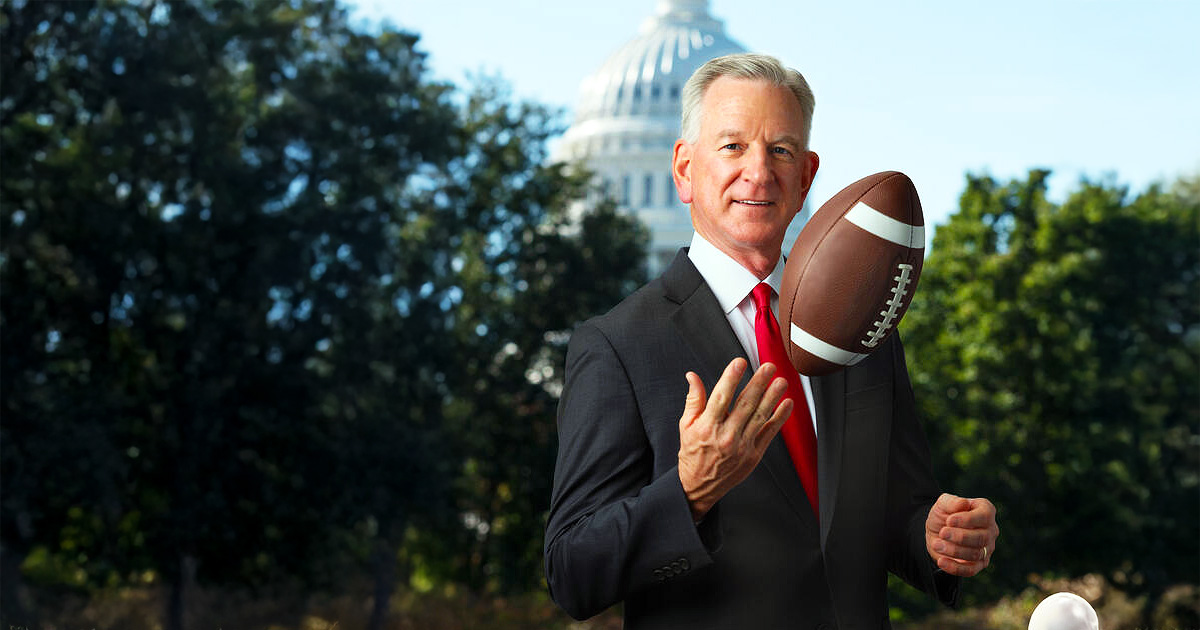
Photo courtesy of the Office of Senator Tommy Tuberville
From Coach to Candidate: Tuberville’s Run for Alabama Governor
A look at his Senate record, policy positions, and how they could shape Alabama’s future
by Joshua Kotlowski | Owner and Writer for Bama Blues
Aubie won’t be the only Tiger hoping for a touchdown in Alabama this November. Senator Tommy Tuberville, the former head coach of the Auburn Tigers, officially announced his candidacy for governor in May 2025 after serving a single term in the Senate. Tuberville has become a recognizable name not only in Alabama politics, but on the national stage as well. His unorthodox campaign style, direct approach to public statements, and sometimes controversial remarks have brought him national attention on multiple occasions.
This all adds up to a candidate with high name recognition, but one many voters may not fully understand beyond the headlines. As Tuberville transitions from federal office to a run for governor, this lack of understanding raises a few important questions: Who is Tommy Tuberville? What is his political platform? And what does he hope to accomplish if he wins in November?
From Playbooks to Politics
Thomas Hawley Tuberville was born and raised in Camden, Arkansas to parents Olive Nell and Charles Tuberville, a World War II veteran. He graduated from Harmony Grove High School in 1972 and later earned a degree in physical education from Southern Arkansas University, where he played safety for the school’s football team.
Tuberville began his coaching career in the late 1970s at Hermitage High School before moving into the college ranks, including a role at Arkansas State. He later joined the University of Miami, where he rose from graduate assistant to defensive coordinator during a period in which the program won three national championships.
Tuberville is a candidate with high name recognition, but one many voters may not fully understand beyond the headlines.
He eventually became head coach at the University of Mississippi, where he made one of his earliest public political statements by supporting a ban on Confederate flags in the stadium, citing its impact on recruiting. In 1999, Tuberville took over as head coach at Auburn University, beginning the most successful stretch of his coaching career. During his tenure, Auburn made eight consecutive bowl appearances and completed an undefeated 2004 season that included an SEC Championship and Western Division title. That season also earned him multiple honors, including AP and SEC Coach of the Year.
After leaving Auburn in 2008, Tuberville went on to coach at Texas Tech while moonlighting as an analyst for ESPN. Later, he had a short stint coaching at the University of Cincinnati before he retired in 2016 and moved to Santa Rosa Beach, Florida.
In 2019, Tuberville entered the world of politics by announcing he would run in the Republican primary for the U.S. Senate seat held by Democrat Doug Jones. His campaign was relatively low-profile compared to opponent Jeff Sessions, but he secured President Donald Trump’s endorsement, which proved decisive. Tuberville defeated Sessions in a runoff and went on to win the general election by a wide margin.
MAGA, Montgomery, and the Message
Since taking office in 2020, Tuberville has served on several Senate committees, including Armed Services, Agriculture, Veterans’ Affairs, and the Health, Education, Labor, and Pensions Committee. During his time in office, he has followed Republican policy priorities and emphasized his commitment to President Trump.
In 2025, Tuberville announced he would not seek re-election to the Senate and would instead run for governor of Alabama in 2026, positioning his Senate record as a central part of his campaign. That campaign platform reflects the policy positions of President Donald Trump, the broader Republican Party, and the MAGA movement, which he has openly embraced.
Economically, he has emphasized lowering taxes, reducing government spending, and rolling back federal regulations, while also supporting efforts to bring manufacturing jobs back to the United States. On immigration, he has backed stricter enforcement measures, including the construction of a border wall and expanded deportation efforts.
His platform reflects conservative policy priorities and strong positions on social and cultural issues.
In education, Tuberville has advocated for expanding school choice, including charter, private, and homeschool options, while also emphasizing parental involvement in curriculum decisions. His positions on education intersect with broader social issues, including opposition to diversity, equity, and inclusion (DEI) programs and the teaching of Critical Race Theory, as well as support for restrictions on transgender athletes participating in women’s sports.
He has also emphasized increased military funding and a more assertive defense posture, while maintaining strong support for Second Amendment protections and opposing additional gun control measures.
The Record Behind the Rhetoric
In the Senate, Tuberville’s voting record reflects those priorities. He has pointed to a 100% voting alignment with Trump-backed positions as part of his campaign messaging.
Tuberville has sponsored or co-sponsored dozens of bills during his time in office, though many did not advance far. Two were ultimately signed into law. The first, the Supporting Families of the Fallen Act, increased life insurance benefits for service members and veterans. The second was a provision included in the National Defense Authorization Act that restricted transgender women’s participation in women’s athletics at military service academies.
His sponsored legislation has largely focused on social and cultural policy, while also branching into agriculture, financial regulation, and veterans’ affairs. Examples include the Protection of Women and Girls in Sports Act, the Farm Board Act, and the Financial Freedom Act, the latter of which would allow cryptocurrency investments in retirement accounts.
Tuberville has also taken several high-profile votes during his time in the Senate. He objected to the certification of electoral votes following the 2020 presidential election and voted against the creation of an independent commission to investigate the January 6, 2021 Capitol attack. He also voted against the COVID-19 Hate Crimes Act, which aimed to expand federal tracking of hate crimes against Asian Americans during the pandemic.
He voted against the Honoring Our PACT Act, which expanded healthcare access for veterans exposed to toxic substances, as well as the Respect for Marriage Act, which established federal protections for same-sex marriage.
A broader look at his legislative activity shows limited bipartisan support, with most of his sponsored legislation backed primarily by Republican colleagues, though some bipartisan cooperation has appeared in areas such as agriculture and veterans’ issues.
The Hold That Made Headlines
Beyond legislation, Tuberville drew national attention in 2023 for placing a hold on military promotions in protest of a Department of Defense policy that provided leave and travel reimbursement for service members seeking abortions. Tuberville argued the policy was an improper use of taxpayer funds and exceeded the department’s authority.
The hold lasted roughly 10 months and delayed more than 400 military promotions.
Military promotions are typically approved in batches by unanimous consent, but the hold forced the Senate to process them individually, significantly slowing confirmations. The hold lasted for roughly 10 months and affected more than 400 promotions, including several senior leadership positions. The move drew criticism from members of both parties and military officials over its potential impact on military readiness, while supporters viewed it as a stand against federal overreach. Tuberville ultimately lifted the hold in December 2023.
Questions, Scrutiny, and the Fine Print
Other aspects of Tuberville’s Senate record have also drawn attention, including financial disclosures, nonprofit activity, and voting participation.
Tuberville has faced criticism for late financial disclosures under the STOCK Act, which requires timely reporting of certain financial transactions. He has said his investments are managed by financial advisors and that he is not directly involved in day-to-day trading decisions.
A nonprofit he founded, the Tommy Tuberville Foundation, has also drawn scrutiny. Tax records show the organization raised nearly $290,000 in its first five years, though a much smaller portion went toward charitable causes. Reporting from The Washington Post noted that some funds were used for administrative expenses, including paying off the remaining balance on an auto loan, raising questions about financial transparency. We wrote more about this and other controversies in our article, “The Tiger in the Room: The Problem with Tommy Tuberville.”
Tuberville has also missed a higher percentage of Senate votes than the chamber’s median, missing 102 votes, or approximately 4.3%, compared to around 2.8% among current senators.
What That Means for Alabama
Tuberville’s Senate record provides context for his candidacy, but his campaign for governor focuses on how those positions translate to state-level policy.
His platform emphasizes lowering taxes, reducing government spending, and bringing manufacturing jobs to Alabama. In education, he supports expanding school choice and increasing parental control over curriculum. The campaign also includes proposals to increase cooperation between Alabama law enforcement and federal immigration authorities, along with continued opposition to DEI initiatives and support for restrictions on transgender athletes.
Other aspects of his record have drawn scrutiny, including financial disclosures, nonprofit activity, and voting participation.
Tuberville has highlighted Alabama’s defense industry, particularly in Huntsville and at Redstone Arsenal. His campaign has pointed to the 2025 selection of Huntsville as the permanent headquarters for U.S. Space Command (SPACECOM) as a potential driver of job growth and economic expansion.
He has also emphasized support for Alabama’s veteran population, which numbers more than 400,000, including improving access to care and benefits.
Taken together, Tuberville’s platform reflects conservative policy priorities and continued attention to the social and cultural issues that have defined his time in the Senate.
The Choice Ahead
Tuberville’s candidacy for governor is shaped by a well-defined public profile built through his coaching career, his time in the Senate, and a campaign centered on conservative economic policies, strong positions on social and cultural issues, and close alignment with national Republican leadership. His record includes a limited number of enacted bills, several high-profile votes, and actions such as his hold on military promotions, along with scrutiny surrounding financial disclosures, nonprofit activity, and voting participation.
When viewed together, that record offers a clear indication of how Tuberville would approach statewide leadership. His legislative history suggests that, if elected, he would prioritize conservative economic policies, continue efforts tied to his opposition to DEI and Critical Race Theory in public education, and expand school choice policies that shift students, and funding, toward private alternatives. His record also points to continued support for restrictive social policies, including limits on abortion access and restrictions on transgender athletes.
Alabama Republicans will have a choice to make in the May primary. Is this the kind of leadership they want to see shaping Alabama’s future?
Bama Blues contacted Doug Jones’ campaign for comment but did not receive a response in time for publication. If a response is received, this article will be updated to reflect it.

Leave a Comment