
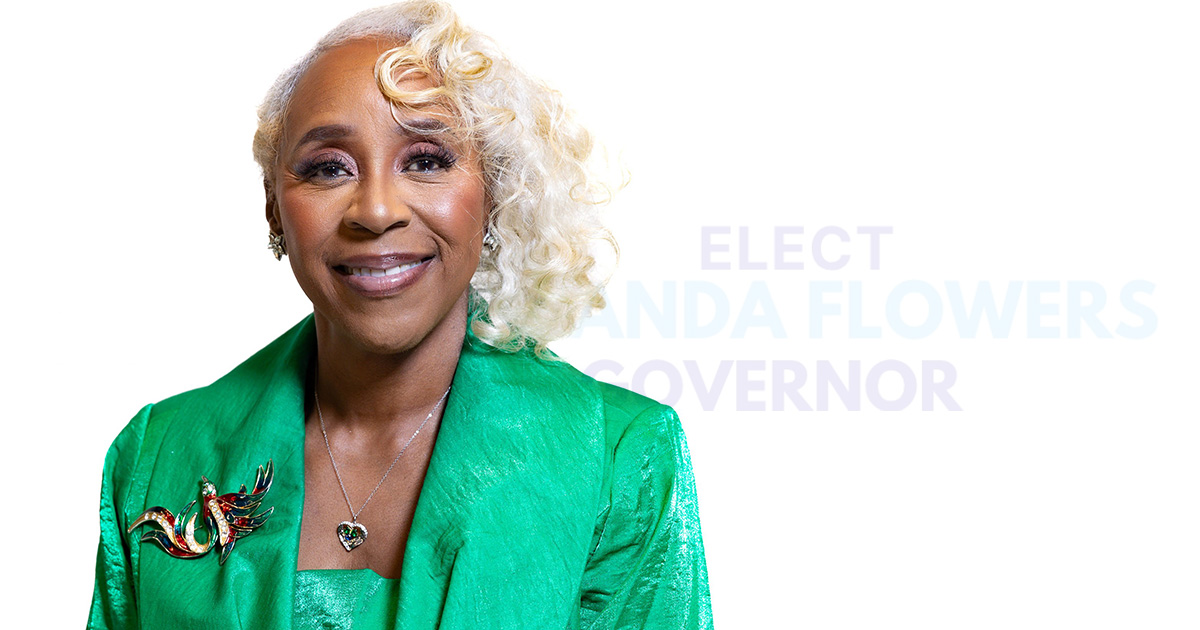
Photo courtesy of Yolanda Flowers / Facebook
Yolanda Flowers and the Case for a New Alabama
From the Classroom to the Campaign Trail: Making the Case for Change in Alabama
by Joshua Kotlowski | Owner and Writer for Bama Blues
In a crowded Democratic field, some names dominate headlines while others fade into the background. Yolanda Flowers falls into the latter category. Despite receiving little media attention, she has put forward arguably one of the most detailed platforms of any candidate in the race, with a strong focus on erasing poverty and reforming many of the state’s struggling institutions.
The Birmingham teacher is not a political newcomer. In 2022, she was the Democratic nominee for governor, facing incumbent Kay Ivey. In doing so, she made history as the first Black woman in Alabama to secure a major party’s nomination for the office. Even with that milestone, she has largely flown under the radar in the 2026 race. It begs the question: who is Yolanda Flowers, and what is her platform?
From Birmingham to the Ballot
Yolanda Rochelle Robinson-Flowers was born in 1961 in Birmingham, Alabama to parents Mr. and Mrs. McConnell Robinson. She describes her parents as humble and hardworking people who instilled in her a strong sense of discipline, faith, and responsibility to family and community. Her parents’ emphasis on structure, she said, has remained central to how she views leadership today. “If both parents do not agree on important issues concerning rules and family law, then the children have no structure,” she said.
Flowers attended school in Birmingham before enrolling at Maryville College in Tennessee. She did not complete her degree at that time, choosing instead to leave school, marry, and focus on raising a family. She and her husband, Curtis Lynn Flowers Sr., went on to have three children, and their family has since grown to include twelve grandchildren and five great-grandchildren.
Later in life, Flowers returned to her education and completed multiple degrees, earning an Associate of Arts in Speech from Pellissippi State Technical Community College, followed by a Bachelor of Arts in Audiology and a Master of Science in Rehabilitation Counseling from the University of Tennessee, Knoxville. That return to school shaped the professional path she would follow for the next two decades.
If both parents do not agree on important issues concerning rules and family law, then the children have no structure.
Yolanda Flowers
Her career was centered around education and rehabilitation. She began as a reading instructor working with students at risk of falling behind, later serving as a speech and language pathologist assistant in local school systems. She also worked as a vocational rehabilitation counselor for the State of Tennessee, helping individuals transition into the workforce. After returning to Alabama, she worked in the Birmingham City School System as a full-time substitute teacher until retiring in 2019.
Flowers would go on to run for governor of Alabama in 2022, becoming the first Black woman in state history to secure a major party’s nomination for the office. That campaign introduced her to voters across the state, and her current run builds on that experience as she once again makes her case to lead Alabama.
Outside of her professional and political life, Flowers describes herself as someone who enjoys simple, personal pursuits. “I enjoy gardening, playing the piano, reading, taking walks with my dog, and spending time with family,” she told Bama Blues. She also notes that many people are surprised to learn that she is both a musician and a singer.
Her background in education, rehabilitation, and community life now informs the policies she is putting forward in her campaign, many of which center on addressing poverty and restructuring systems she argues are failing working Alabamians.
Root Causes Over Quick Fixes
At its core, Flowers’ political views are shaped by a belief that many of the systems people rely on are not functioning in a way that supports those who need them most. Much of her thinking centers on poverty and how it impacts nearly every aspect of life, from health to education to involvement in the criminal justice system.
As a result, her views on the economy are specific and detailed, reflecting a focus on fulfilling basic needs and providing financial stability. She argues that people who work should be able to meet the cost of living and that financial insecurity caused by low wages creates ripple effects across families and communities. Alongside that, she places importance on access to food, transportation, and financial literacy, emphasizing both immediate support and long-term self-sufficiency.
On healthcare, Flowers has said access to care should not be determined by income. She has pointed to the rising cost of insurance and gaps in coverage as barriers that leave many people without consistent access to treatment. In her view, healthcare is not only a personal issue, but one that affects the overall strength and stability of communities.
A hungry brain cannot function.
Yolanda Flowers
Her approach to education extends beyond academics. She has emphasized the importance of addressing students’ physical and mental well-being alongside traditional classroom instruction. “A hungry brain cannot function,” she said, underscoring her belief that a student’s environment plays a critical role in their ability to learn. She has also spoken about the importance of how history is taught, particularly when it comes to ensuring that students receive a more complete and honest understanding of the past.
Flowers’ thinking on criminal justice is rooted in rehabilitation rather than punishment alone. Drawing on her background in rehabilitation counseling, she has emphasized the need for systems that focus on reintegration and second chances. She has also linked many of the challenges within the justice system to broader socioeconomic conditions, particularly poverty.
Underlying many of these views is a strong religious foundation that Flowers says shapes how she approaches government itself. She has said her beliefs differ from others in her party in that she sees faith and governance as closely connected. “I strongly believe that God and Government go together, that you cannot have government without the governor of the universe,” she said. “He is the lawgiver; he is the government.” She also points to the Word of God as the primary influence on her thinking, alongside figures like Shirley Chisholm, reflecting a worldview that blends faith with a focus on political and social change.
“I strongly believe that God and Government go together, that you cannot have government without the governor of the universe.”
Yolanda Flowers
Taken together, Flowers’ views reflect a belief that many of Alabama’s challenges are interconnected and rooted in deeper structural issues. Her approach emphasizes addressing those root causes through economic support, expanded access to essential services, and a greater focus on rehabilitation and long-term stability. Those ideas form the foundation of the policies she is now proposing as part of her campaign for governor.
Turning Ideals Into Policy
Building on those views, Flowers has outlined a wide-ranging set of proposals aimed at addressing what she sees as the root causes of poverty and instability across the state.
On the economic front, she has called for raising Alabama’s minimum wage to $15 an hour and has criticized the Ivey-era law that prohibits municipalities from setting local wages above the federal minimum, arguing that it makes raising wages in the state effectively impossible without federal approval. She has also proposed eliminating the remaining state tax on groceries and maintaining funding for programs like SNAP, which she views as essential for ensuring food security.
Flowers has also spoken on the ongoing energy rate debate involving Alabama Power and the Public Service Commission, an issue shaping up to be one of the most important for voters this year. She has said she would support rate hearings under oath to address what she described as “outrageous rates and charges,” while also backing a more transparent approach to regulation, with data made publicly available and subject to oversight. She has further expressed support for allowing voters to elect merit-based candidates to the commission, pushing back against recent legislative efforts to shift control over those appointments.
In addition, Flowers has emphasized the need for expanded public transportation across the state, particularly for low-income residents who may struggle to access jobs, education, and healthcare without reliable transit. “I will propose free transportation through ATRC, TRAM (statewide) to accommodate individuals who do not have transportation to address urgent needs, regardless of whether they have a disability, or for student services,” she told Bama Blues.
Her plans for transit expansion intersect with her goals for healthcare access, where she has suggested expanding transportation services to help residents reach medical care when it is not available locally. Flowers also supports expanding Medicaid and Medicare, saying those programs should “be available for ALL seniors and those with disabilities.” She has also proposed broader healthcare reforms aimed at covering those who fall outside traditional eligibility requirements, arguing that too many Alabamians are left without affordable options.
I will propose free transportation… to accommodate individuals who do not have transportation to address urgent needs.
Yolanda Flowers
Flowers also expressed a deeply personal perspective on abortion policy. She told Bama Blues that she was abused as a child and did not fully understand the impact it had on her until later in life. “I suffered from depression, anger, and fear,” she said. “Because of God’s healing power, I can forgive; however, it took much longer to be freed from fear. Now, I am fighting for females of all ages, reassuring them that our bodies are our bodies and no one has the right to take away our choice to do what we desire to do or have to do with our bodies.”
In education, Flowers has proposed a series of changes that reflect her focus on both academic performance and student well-being. She supports providing free, nutritious meals to all public school students and has called for increased attention to mental health through psychological assessments. Her platform also includes greater parental involvement through structured home visits and improved oversight of school facilities. She has also been critical of recent state policies affecting how history is taught, arguing for a more complete and accurate presentation of subjects like the Civil Rights Movement. Additionally, she has raised concerns about the state’s school choice policies, particularly the diversion of public funds to private and homeschooling programs.
Flowers’ approach to criminal justice includes a number of structural reforms aimed at reducing incarceration and addressing disparities within the system. She has proposed the use of categorical clemency to address past injustices, along with the commutation of sentences for elderly, medically vulnerable, and mentally ill individuals. She has also called for changes to how parole decisions are made, including appointing leaders who prioritize rehabilitation and equity. More broadly, her plan reflects an effort to shift the system toward reintegration rather than long-term incarceration.
She has also called attention to HB228, a bill currently pending in the Alabama Senate that would combine bail and preliminary hearings into a single process with a strict 10-day timeline. Flowers has questioned whether adequate investigation and due process would be possible under those conditions, arguing that such changes could limit a defendant’s ability to fully prove their innocence.
Taken together, Flowers’ proposals reflect a focus on expanding access to basic needs, increasing transparency in government, and addressing the economic pressures she believes are driving many of the state’s systemic challenges. From wages and healthcare to education and criminal justice, her approach centers on using the governor’s office to reshape systems she argues are not currently serving everyday Alabamians.
A Different Vision for Alabama
Yolanda Flowers is running on a platform centered around addressing poverty and expanding access to the basic needs she believes many Alabamians are currently struggling to meet. For voters, her proposals would translate into higher wages, broader access to healthcare, increased investment in public education, and a shift in the criminal justice system toward rehabilitation rather than punishment.
My motivation to run was to change the course of our state.
Yolanda Flowers
That shift could carry significant real-world implications. As outlined in Mercy in Montgomery, Alabama’s criminal justice system has faced ongoing scrutiny, particularly in its use of the death penalty. Flowers’ emphasis on clemency, sentence commutations, and systemic reform could, if implemented, lead to fewer executions and potentially prevent cases where individuals, particularly Black men, may be wrongfully convicted.
At the core of her campaign is a stated desire to move beyond what she sees as partisan dysfunction. “My motivation to run was to change the course of our state,” she told Bama Blues. “Neither the Democratic Party nor the Republican Party conducts business unilaterally. They have their own agenda, which does not include the well-being of the people.” That perspective, combined with her focus on economic stability and structural reform, forms the foundation of her argument for a different approach to governing Alabama.
Whether that vision resonates with voters remains to be seen as the race continues to take shape.

2 responses to “Yolanda Flowers and the Case for a New Alabama”
-
Thank you, Josh, for such a beautiful article. You captured what was in my heart and brought it out in living color. You are a sensational writer and a real warrior. Not many people can handle the challenges you face, based on your synoptic bio, and be victorious. I bow to you, Sir! May God continue to use you mightily for His service to the people.
Kindly affectionate,
Yolanda Flowers-
I appreciate the kind words, Mrs. Flowers.
-


Leave a Comment