
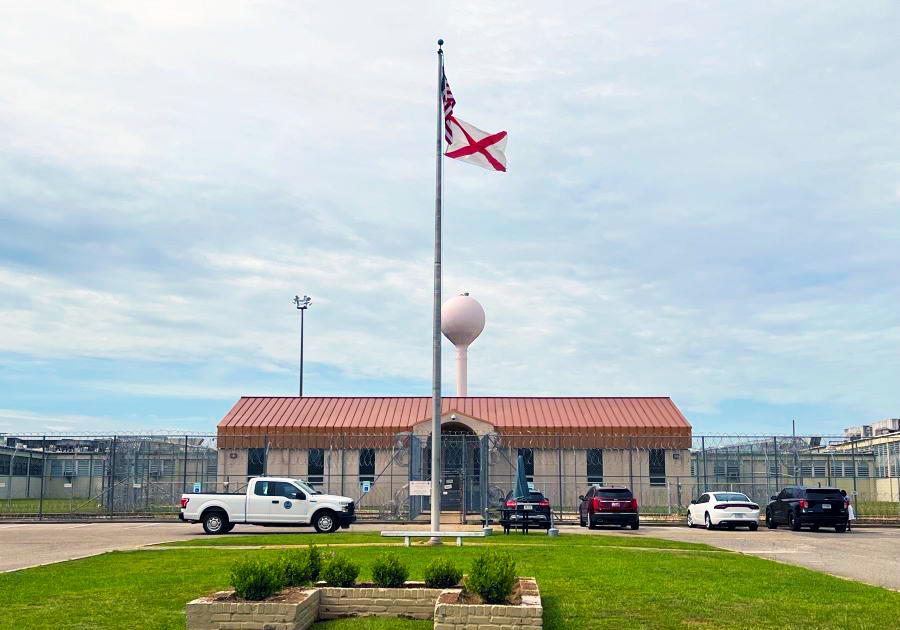
William C. Holman Correctional Facility | Alabama Department of Corrections
Mercy in Montgomery: Sonny Burton and Alabama’s Death Penalty
Wrongful Convictions, Botched Executions, and an Experiment in Nitrogen Gas
by Joshua Kotlowski | Owner and Writer for Bama Blues
Charles Lee Burton, known as “Sonny” to those close to him, has a new lease on life after Governor Kay Ivey commuted the 75-year-old’s death sentence on Tuesday.
Burton was convicted of capital murder in 1992 following the shooting death of Doug Battle during a botched robbery of an AutoZone in Talladega. Burton was part of the group that committed the robbery, but he did not pull the trigger. That was done by another man, Derrick DeBruce. Court testimony showed that Burton and the other robbers had already left the store when Doug Battle entered and confronted DeBruce. The encounter proved fatal when DeBruce shot Battle in the back.
Burton has long denied being involved in the shooting. In a telephone interview, he said, “I didn’t know anything about nobody getting hurt until we were on the way back. No, nobody supposed to get hurt.”
Despite his testimony, and testimony from others at the scene backing him up, Burton was still sentenced to death by a jury due to a legal doctrine known as the felony murder rule. This doctrine, used in most states, allows prosecutors to charge participants in certain serious felonies with murder if someone dies during the commission of the crime, even if the accused did not personally commit the killing.
While critics argue that the rule can punish people too harshly for deaths they did not intend or cause, it rarely generates widespread public attention. Burton’s case, however, is different. The man who did pull the trigger, Derrick DeBruce, had his own death sentence overturned in 2014 after a court ruled that he had received inadequate legal counsel. That decision left Burton as the only participant in the robbery still facing execution
In the years since, support for commuting Burton’s sentence has grown among his family and friends, members of the public, and even within the victim’s own family. Doug Battle’s daughter, Tori Battle, wrote in an op-ed for the Montgomery Advertiser last December that when the Attorney General’s office contacted her about Burton’s scheduled execution, she made it clear she did not want it to proceed.
“No one from the state has ever sat with me to explain why Alabama believes it must execute a man who did not kill my father,” she wrote.
Sonny Burton’s case should be a rare legal anomaly. In Alabama, it is just the latest entry in a long and troubling history.
No one from the state has ever sat with me to explain why Alabama believes it must execute a man who did not kill my father.
Tori Battle
A System With a Long Memory
The state has carried out dozens of executions since the death penalty was reinstated in the 1970s, and controversy has followed the system ever since. Wrongful convictions, botched executions, questionable legal practices, and the introduction of a new execution method that has drawn criticism from around the world have done little to improve Alabama’s reputation. Burton’s case is simply drawing renewed attention to a system that critics say has been plagued by problems for years.
The most troubling aspect of any death penalty system is the possibility that an innocent person could be executed. While supporters often argue that appeals and safeguards make such an outcome unlikely, history shows the system is not infallible. And even when it does work as they claim, people often lose decades of their lives while fighting to prove their innocence.
Alabama has seen multiple instances just like this, cases that collapsed after years of legal challenges. One of the most well-known examples is Anthony Ray Hinton, who spent nearly thirty years on death row for two murders he did not commit. Hinton’s conviction relied almost entirely on ballistics testimony that prosecutors claimed linked bullets from the murders to a gun found in his home. Decades later, independent forensic experts determined the bullets were not from that weapon at all. In 2015, after the United States Supreme Court ordered a new review of the case, prosecutors dropped the charges entirely and Hinton was finally released after nearly three decades behind bars.
“Anthony Ray Hinton spent nearly thirty years on death row for murders he did not commit.”
Another widely cited case is that of Walter McMillian, who was sentenced to death in 1987 for the murder of an eighteen-year-old woman in Monroeville. The prosecution’s case depended largely on the testimony of a single witness who later admitted he had lied under pressure from investigators. Evidence that McMillian had been at a church event at the time of the murder was even ignored during the trial. After years of legal appeals and an investigation led by the Equal Justice Initiative, McMillian’s conviction was finally overturned in 1993 and he was released.
Cases like these serve as a stark reminder that the criminal justice system is capable of making serious mistakes. When those mistakes occur in ordinary criminal cases, they can sometimes be corrected years later. When the punishment is execution, however, time is limited and the consequences are irreversible.
The Execution of Nathaniel Woods
One of the most widely debated executions in recent Alabama history was that of Nathaniel Woods. In 2004, three Birmingham police officers were shot and killed while attempting to serve a warrant at an apartment. The man who fired the shots was Kerry Spencer, who admitted to being the gunman. Woods, however, was present at the scene and prosecutors argued that his actions helped lead to the deadly confrontation.
Under Alabama’s accomplice liability laws and the broader felony murder doctrine, that involvement was enough to secure a death sentence even though Woods had not fired the weapon. The case drew national attention in the days leading up to the execution. More than a million people signed petitions asking Gov. Kay Ivey to grant clemency, the lead prosecutor from Woods’ original trial supported commuting his sentence, and Spencer himself spoke out saying that Woods should not be executed for a crime he did not commit.
Despite those appeals, Alabama carried out the execution on March 5, 2020.
More than a million people signed petitions asking Governor Kay Ivey to grant clemency.
When Executions Go Wrong
Even when the law is fully on its side, Alabama has struggled to carry out executions in a consistent and “humane” manner. In recent years, several attempts to perform executions have devolved into chaotic and deeply troubling procedures, with some witness accounts describing the ordeals as disturbing.
One of the most infamous examples occurred in 2018 during the attempted execution of Doyle Hamm. Hamm, who was suffering from terminal cancer and had severely compromised veins, warned the state that establishing the intravenous lines required for lethal injection would be extremely difficult. Despite those warnings, prison staff attempted to carry out the execution anyway.
For more than two hours, they repeatedly attempted to insert IV lines into Hamm’s body, probing his legs, groin, and abdomen in an effort to find a usable vein. Witnesses described the scene as painful to watch and highly disorganized, with Hamm left bleeding and struggling on the gurney while officials continued searching for access points. Eventually, after hours of painful attempts, the execution was called off entirely after they were unable to establish the IV.
The incident drew widespread condemnation and prompted legal challenges over whether the state had effectively subjected Hamm to cruel and unusual punishment during the failed attempt. Hamm died of natural causes the following year.
Concerns about Alabama’s execution procedures surfaced again in 2022 during the execution of Joe Nathan James Jr. Witnesses were brought into the execution chamber but were forced to wait nearly three hours before the procedure began. During that time, prison officials refused to explain the delay.
Later reports suggested that prison staff had again struggled to establish the IV lines required for lethal injection. When James was finally executed, the state offered few details about what had occurred during the three-hour wait. Photographs taken during an autopsy later revealed numerous puncture marks on James’ arms and hands, fueling speculation that prison staff had encountered the same difficulties that plagued the Hamm execution years earlier.
Incidents like these generated widespread outrage and raised serious concerns about the state’s ability to carry out executions in accordance with federal law. After multiple failed or highly controversial lethal injection attempts, Alabama made a decision that would draw even greater scrutiny: becoming the first place in the world to carry out an execution using nitrogen gas.
Alabama’s New Execution Method
In 2018, after years of criticism relating to the state’s difficulties with lethal injections, Alabama lawmakers began searching for alternatives. Their answer was a new method of execution known as nitrogen hypoxia. The procedure involves forcing a prisoner to breathe pure nitrogen through a mask, depriving the body of oxygen until unconsciousness and eventually death.
Supporters claimed nitrogen hypoxia could provide a more reliable method of execution at a time when states across the country were facing shortages of lethal injection drugs and repeated difficulties establishing IV lines. Critics, however, warned that the method had never been used in an execution anywhere in the world and that there was little scientific evidence to support claims that it would be painless or humane.
For several years, the method remained largely theoretical, existing only on paper and in policy discussions. That changed in 2024.
On January 25, 2024, Alabama carried out the first nitrogen gas execution in history. The prisoner was Kenneth Eugene Smith, who had been convicted in a murder-for-hire plot in 1988. Smith’s execution was controversial even before the nitrogen gas procedure began. In 2022, the state had already attempted to execute him by lethal injection, but the attempt was called off after officials failed to establish the IV lines required for the procedure. Critics argued that a second attempt at execution, especially using an entirely new and untested method, raised serious ethical concerns.
Witness accounts from the execution chamber appeared to confirm those fears. Observers described Smith shaking violently and writhing on the gurney, struggling against his restraints for several minutes after the nitrogen gas began flowing. Witnesses also reported heavy breathing and said the process lasted significantly longer than state officials had suggested it would. The disturbing descriptions quickly spread across social media and news outlets, sparking a national debate about whether the procedure had caused unnecessary suffering.
Despite the controversy, Alabama officials declared the execution a success.
Witnesses described Kenneth Smith shaking violently and struggling against the restraints.
Later that same year, Alabama carried out a second nitrogen gas execution. Alan Eugene Miller was put to death in September 2024 after surviving a failed lethal injection attempt in 2022. Like the Smith execution, witnesses described violent shaking, pulling against restraints, and gasping for air for several minutes before Miller eventually became still. State officials acknowledged the movements and gasping but claimed they were “expected involuntary reactions” rather than signs of suffering.
Critics accused Alabama of effectively using condemned prisoners as test subjects for a method that had never previously been attempted in an execution. The fact that both Smith and Miller had already endured failed lethal injection attempts only intensified the debate. Opponents of the death penalty argued that the state was repeatedly subjecting prisoners to traumatic execution procedures in its effort to carry out death sentences.
The executions quickly drew attention far beyond Alabama. Human rights organizations around the world condemned the practice, arguing that the state was conducting a dangerous experiment with human lives. The United Nations High Commissioner for Human Rights warned that the use of nitrogen hypoxia could violate international prohibitions against cruel, inhumane, or degrading punishment. Medical experts and legal scholars echoed those concerns, noting that the effects of the method had never been thoroughly studied in the context of executions.
Ultimately, the controversy surrounding nitrogen gas executions goes far beyond the mechanics of a single execution method. Alabama’s history of wrongful convictions, controversial death sentences, and troubled execution procedures had already raised serious questions about the reliability of the system. The adoption of what many critics view as a cruel and experimental method intended to address consistency concerns has only added to those doubts.
The Question Alabama Must Answer
Sonny Burton’s commutation does not erase the decades he spent living under the state’s threat of death, nor does it erase the broader moral concerns surrounding state executions to begin with. But it does raise an important question about the system that placed him there in the first place.
Over the course of this article, we’ve looked at a number of cases that illustrate the broader problems surrounding the death penalty, not just in Alabama, but across the entire nation. The stories of Anthony Ray Hinton and Walter McMillian are not unique to this state. Innocent people have lost decades of their lives to wrongful convictions, forced to live under the fear of execution for crimes they did not commit. The story of Nathaniel Woods is not unique either. He is not the first person to be executed for a crime he did not personally commit, and he will almost certainly not be the last.
Supporters of capital punishment often argue that the death penalty is necessary to deliver justice for the most serious crimes. But cases like Burton’s highlight a difficult truth: even when the system functions exactly as it was designed, the results can still have dramatic consequences for people’s lives and raise profound moral and legal questions. A system that risks executing the innocent, struggles to carry out executions humanely, and now relies on an experimental method never before used in the world is a system that demands serious scrutiny.
The question Alabama voters and lawmakers alike must now confront is a simple one: after decades of controversy, mistakes, and failed procedures, should the state still have the power to take a life? It’s a question we should all be considering right now.
Charles “Sonny” Burton will spend the rest of his life in prison, but he will at least have the chance to live it.
Others have not been so fortunate.

Leave a Comment