
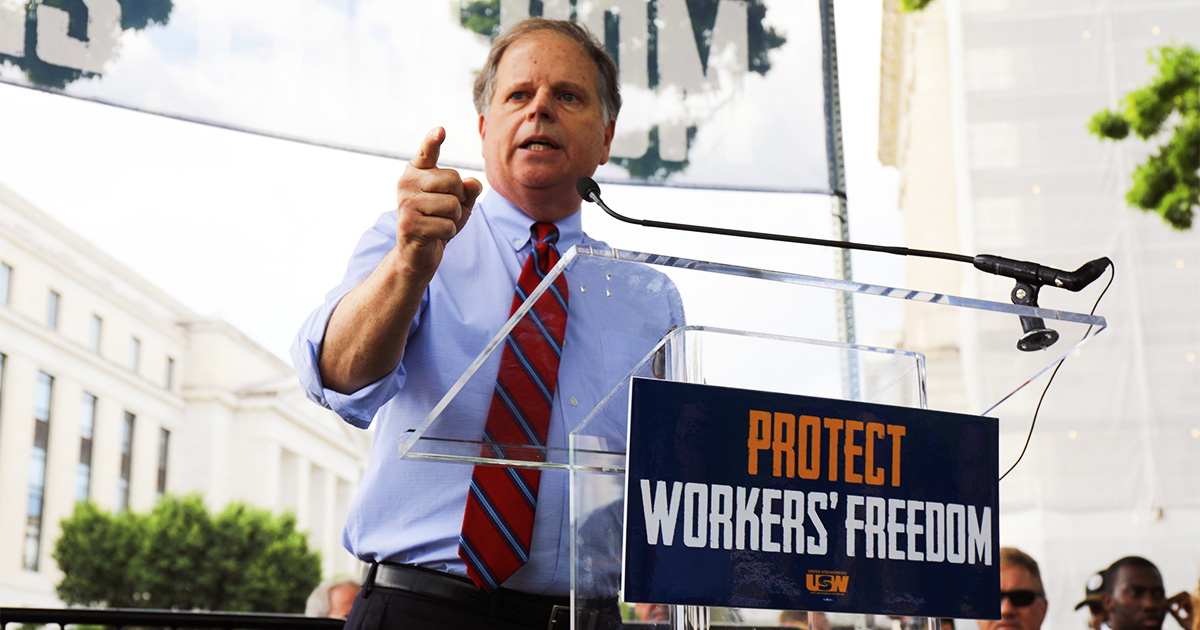
Doug Jones speaking in support of the United Steelworkers. | United States Senate – Office of Doug Jones
Doug Jones: The Moderate Democrat Trying to Win Alabama Again
A former U.S. Senator positions himself as a centrist alternative in a state that has grown increasingly skeptical of his party.
by Joshua Kotlowski | Owner and Writer for Bama Blues
Doug Jones remains one of the most recognizable names in Alabama politics today. With a solid track record in Congress and a proven ability to win a statewide election, he is the clear frontrunner for the Democratic nomination in May’s primary.
But who is Doug Jones? What does he actually stand for? And what does he want for Alabama if he wins in November?
Who Is Doug Jones?
Jones is a former U.S. Senator from Alabama whose political career is defined by a rare achievement: winning a statewide election as a Democrat in a deeply conservative state. His 2017 victory over former Alabama Supreme Court Justice Roy Moore made him the first Democrat to hold the seat in decades.
That is not his only major accomplishment. In 1997, President Bill Clinton appointed Jones as U.S. Attorney for the Northern District of Alabama. In that role, he led the successful prosecution of two Ku Klux Klan members responsible for the 1963 bombing of the 16th Street Baptist Church in Birmingham, which killed four young girls.
He also secured an indictment against domestic terrorist Eric Rudolph, who carried out a series of bombings across the southeastern United States in the late 1990s, including the Centennial Olympic Park bombing during the 1996 Summer Olympics in Atlanta.
What Are His Beliefs?
Jones presents himself as a moderate Democrat, and his record largely reflects that positioning. On social issues, he has generally aligned with his party, supporting abortion rights with some limitations, backing same-sex marriage, and advocating for protections for transgender individuals. On healthcare, he has favored incremental reform over sweeping changes. He opposed efforts to repeal the Affordable Care Act and has expressed openness to a public option, while stopping short of endorsing a single-payer system.
He has taken a more measured approach in areas such as gun policy and criminal justice. He supports expanded background checks but opposes an outright ban on assault weapons, reflecting an effort to balance Democratic priorities with the realities of a conservative state. In criminal justice, he voted for the First Step Act and has supported rolling back overly harsh mandatory minimum sentencing laws.
Jones isn’t running as a typical Democrat in Alabama. He’s running as an alternative to what voters think a Democrat is.
Economically, Jones has positioned himself as a pro-growth Democrat focused on workforce development and practical investment. He has not called for tax increases on wealthier Americans and has supported lowering corporate taxes, signaling a more business-friendly approach than many in his party. He has also backed efforts to expand rural broadband, address teacher shortages, and allow employers to assist with student loan repayment.
On national security and foreign policy, Jones has often taken more conservative-leaning positions. He has supported increased defense spending, citing its importance to Alabama’s economy, and has backed measures aimed at countering China’s influence. He voted to confirm Mike Pompeo as Secretary of State and opposed a resolution to end U.S. support for the Saudi-led intervention in Yemen. Together, these positions reinforce his image as a Democrat willing to break with his party in key areas.
What Does He Want for Alabama?
Jones’ campaign for governor places a strong emphasis on how Alabama has been governed under long-term one-party control. He argues that state leadership is insulated from voters, pointing to the lack of early voting and the continued use of straight-ticket ballots as signs of a system designed to maintain power rather than invite meaningful participation. His campaign frames these changes as basic steps toward making state government more responsive and accountable.
Healthcare remains a central focus of his vision for the state. Jones has called for Medicaid expansion, tying the difficulty of securing coverage to both Alabama’s high rates of chronic illness and the ongoing closure of rural hospitals. He has also highlighted the state’s poor maternal health outcomes and voiced support for protecting access to IVF and contraception, framing these issues as everyday realities rather than political flashpoints.
Economically, his campaign focuses on what it describes as a broader sense of stagnation. Jones points to a lack of high-paying job opportunities, especially for younger Alabamians, as a key reason people are leaving the state. He has raised concerns about automation and AI, as well as rising energy costs that are becoming harder for families to manage. He also supports establishing a state lottery, arguing that Alabama is losing millions in revenue to neighboring states.
More broadly, Jones is attempting to position himself as an alternative to the tone that has dominated Alabama politics for a generation. His campaign emphasizes a less confrontational, less divisive approach, rejecting the idea that politics must be a constant battle between opposing sides. Unity has long been central to his message, and his campaign for governor continues that approach.
The Bottom Line
At the core of that message is a clear effort to define himself as distinct from the national image of the Democratic Party. Jones has consistently presented himself as a moderate and a centrist, rather than a candidate aligned with the party’s progressive wing. In a state where Republicans have spent years framing Democrats as “radical leftists,” he is attempting to draw a clear line between himself and that label.
His record and campaign both reflect that strategy. On several issues, he has taken positions closer to the political middle, and at times in alignment with more conservative viewpoints, particularly on economic and national security matters. The goal is not to outflank Republicans from the left, but to convince voters that he occupies a different political space entirely.
Whether that distinction is enough to overcome Alabama’s broader political alignment remains to be seen.
Bama Blues contacted Doug Jones’ campaign for comment but did not receive a response in time for publication. If a response is received, this article will be updated to reflect it.

Leave a Comment