
Ollie Atkins, White House Photographer
Yes, Alabama Used to Be Blue. But it’s Not the Story You Think.
A look at how party labels changed while Southern politics stayed the same.
by Joshua Kotlowski | Owner and Writer for Bama Blues
A topic that gets a significant amount of discussion on social media and message boards is the South’s history as a Democratic stronghold during the era of Abraham Lincoln. Conservatives often point to this as a “gotcha” in discussions surrounding slavery, racism, and civil rights. They will happily explain that Lincoln was a Republican and that it was his party who freed the slaves.
At first glance, this argument seems convincing. The problem is that it leaves out a huge and very important part of the story.
It is common knowledge that Alabama did, in fact, used to be a blue state. What is less well known is that being a Democrat did not always mean being liberal, and being a Republican did not always mean being conservative. Political parties and the ideologies that shape them are not static. They grow and evolve over time. The party of Trump is not the same as the party of Lincoln.
Political parties are not static.
The party of Trump is not the same as the party of Lincoln.
So has Alabama ever been a blue state?
The answer is a confusing yes and no. To understand why, we have to look at how the Democratic and Republican parties have changed over time and why the South aligned so strongly with one party for nearly a century.
When Democrats Were the Conservative Party
Mid-to-late 1800s America can feel like a political bizarro world when viewed through a modern lens.
The Democratic Party was a strong defender of states’ rights and limits on federal power. The party opposed nationalizing the banks and preferred so-called “hard currencies” like gold and silver. They were also strong supporters of free-market capitalism. Democrats were expansionists as well, fully backing the idea of Manifest Destiny, which claimed a divine mandate for the United States to expand across the North American continent.
Meanwhile, the fledgling Republican Party, founded in 1854, believed in a stronger central government and significant federal investment, especially for infrastructure and public education. Republicans were staunchly pro-Union and supported policies they believed would strengthen the nation economically while expanding opportunity for workers. It would later become a champion of civil rights during Reconstruction.
And then there was the issue of slavery. Republicans were firmly opposed to the spread of slavery into new territories, which put them into direct opposition to the Democratic Party and fueled the political crisis that led to the Civil War. Because of this divide, Southern states overwhelmingly rejected the Republican Party.
Reconstruction and the Birth of the Solid South
After the Civil War ended in 1865, the political landscape of the South changed dramatically. During Reconstruction, the federal government worked to rebuild the former Confederate states and integrate the millions of formerly enslaved people into society. Federal troops were stationed throughout the South to enforce new laws and constitutional amendments that granted citizenship and voting rights to Black Americans. These new voters overwhelmingly supported Republicans in elections, which drastically changed the political makeup of the region.
For a short time, this led to something that would seem almost unthinkable today: progressive political power in the South.
But that period did not last.
For a short time after the Civil War, the South experienced something that would seem unthinkable today: progressive political power.
White political leaders across the South organized fierce resistance to Reconstruction. Groups such as the Ku Klux Klan rose to power and used terror and intimidation to suppress Black political participation and undermine Republican political influence. By the late 1870s, Reconstruction effectively came to an end. Federal troops were withdrawn from the South, and without protection from the federal government, Black voter participation sharply declined. This allowed white Democratic leaders to retake control of state governments across the region.
What followed was the creation of what historians call the Solid South.
For decades, Southern states voted overwhelmingly for Democratic candidates at nearly every level of government. The party used poll taxes, literacy tests, and other discriminatory laws to effectively bar Black citizens from voting. For the next sixty years, the conservative Democratic Party’s control of the South seemed unshakable. But by the mid-20th century, the first cracks were beginning to show.
When the Democratic Coalition Began to Crack
Franklin D. Roosevelt was not a typical Democrat of the time. He introduced a new vision for the party that challenged many of its long-standing political traditions. The old Democratic emphasis on small government and strict states’ rights began to give way to large-scale federal programs designed to combat the Great Depression. Programs like Social Security dramatically expanded the role of the federal government in American life.
Roosevelt also reshaped the party’s political coalition. His support increasingly came from urban workers, labor unions, Black voters, immigrants, and working-class Americans across the country. This new alliance would redefine the Democratic Party for decades.
While many Southern Democrats supported Roosevelt and his New Deal programs because of the economic relief they provided during the Great Depression, they also strengthened the growing fear that the federal government might again intervene in the way the South conducted its politics. That tension would continue to grow in the decades that followed.
The first major rupture came in 1948, when the national Democratic Party began openly supporting civil rights reforms. A group of conservative Southern Democrats, led by Strom Thurmond, broke away and formed their own party, commonly known as the Dixiecrats. Their platform focused on preserving racial segregation and states’ rights.
The movement was short-lived, but it revealed a growing divide between the more liberal national Democratic Party and its conservative Southern base.
That rift only grew during the Civil Rights Movement of the 1950s and 1960s. As the national party increasingly supported civil rights legislation, many white Southern voters began to feel politically alienated from the party they had supported for generations.
The breaking point came with the passage of the Civil Rights Act of 1964 and the Voting Rights Act of 1965. These landmark laws outlawed segregation and protected voting rights for Black Americans at the national level.
But for many Southern voters, those laws meant the Democratic Party was no longer the political home it had been for nearly a century.
The Civil Rights Act and Voting Rights Act shattered the century-long political alliance between the South and the Democratic Party.
The Southern Strategy and the Republican Shift
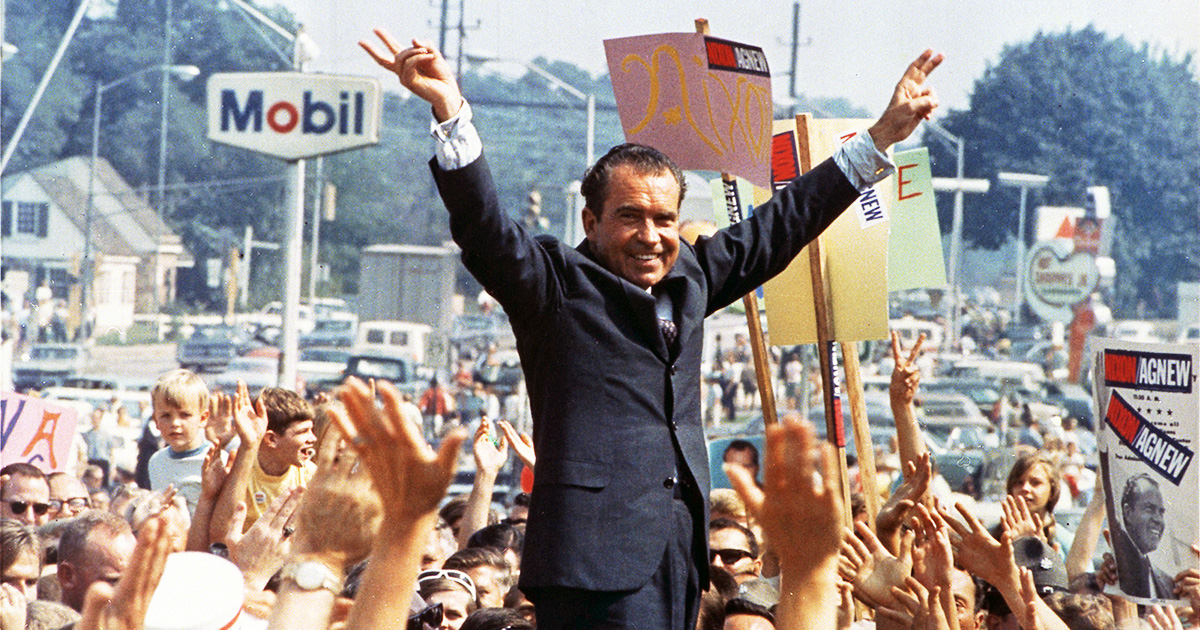
The Civil Rights laws of the 1960s did not transform the South into a Republican stronghold overnight, but the political realignment had begun. The 1968 presidential campaign of Richard Nixon would signal the beginning of that shift. Nixon’s campaign emphasized themes such as states’ rights and opposition to federal overreach, while also using racially coded rhetoric that resonated with voters who opposed desegregation and the rapid social changes of the Civil Rights era. Nixon also worked to build relationships with influential Southern politicians such as the previously mentioned Strom Thurmond.
Nixon’s Southern Strategy was not an instantaneous transformation, but it helped accelerate a growing backlash against civil rights reforms and encouraged many Southern voters to begin shifting toward the Republican Party. Over the following decades, that gradual shift reshaped Southern politics. Republican politicians began running on platforms that looked strikingly similar to the Democratic platforms of the 1850s and started winning elections across the South.
By the early 2000s, the transformation was largely complete. The American South, Alabama included, had become the most reliably Republican region in the country.
Nixon’s Southern Strategy accelerated a political shift that had already begun in the wake of civil rights reforms.
So was Alabama ever a blue state?
In terms of party labels, the answer is yes. But in terms of political ideology, the answer is a firm “not really.” The Democratic Party that once dominated Southern politics was not the same Democratic Party that exists today, just as the Republican Party of Donald Trump is a far cry from what the Party of Lincoln once represented.
You can take the conservatism out of the party.
But you can’t take the conservatism out of the South.

Leave a Comment