
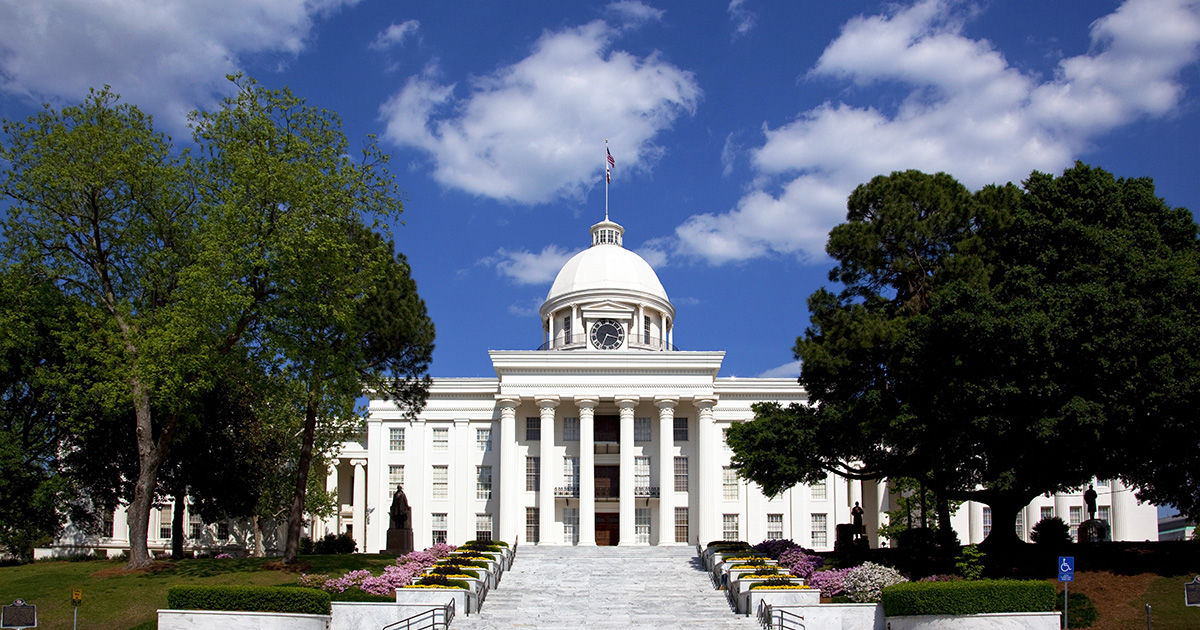
The Alabama State Capitol in Montgomery.
Photo by Carol M. Highsmith / Library of Congress (Public Domain)
Why I Started Bama Blues
by Joshua Kotlowski | Owner and Writer for Bama Blues
For as long as I can remember, I’ve felt out of place in Alabama.
When I was younger, I didn’t know why. I didn’t have the language for it, and I didn’t yet understand the cultural and political forces shaping the world around me. I only knew that something about the place I was growing up in never quite felt like it belonged to me, that it felt fundamentally incompatible with who I was becoming.
As I got older, that feeling began to take shape. I realized that many of the values I believed were fundamental, like treating people with dignity, showing compassion, and respecting those who are different from us did not always seem to apply evenly in the world around me. The gap between what I had been taught growing up and what I often saw in practice was hard to ignore. But at a young age, I couldn’t analyze it that way. I just knew that I wanted to get out of Alabama whenever I could.
In my teenage years, that impulse showed up in all kinds of ways. If friends were driving hundreds of miles for a card tournament I knew I wasn’t good enough to win, I still wanted to go. If my dad was traveling to preach at churches in Michigan or Ohio, I volunteered to tag along even though I had no interest in church itself. If someone I barely knew from another state wanted to meet up, I was willing to spend nearly a day on a Greyhound bus just to make the trip.
Looking back, I realize all the traveling wasn’t really about tournaments or road trips. They were about curiosity. I wanted to see what the rest of the country was like, and I wanted to know if there were places where I felt like I fit in more naturally. For a long time, though, I never fully understood why I felt the way I did. But politics would eventually help me put some of those feelings into context.
I first became interested in politics during the 2008 election. Like many young people at the time, I was drawn to Barack Obama’s message of change and the possibility that our political system might actually start working better for ordinary people. Even at eighteen, I had a sense that something about our economy and our political system felt unfair to the vast majority of people. But over the years that followed, my enthusiasm faded. Washington seemed to move slowly, large structural problems remained in place, and partisan fighting dominated the conversation for the entirety of the Obama presidency. Yes, I still voted and kept up with major events, but I wasn’t deeply engaged anymore
That changed in 2015.
Bernie Sanders entered the presidential race and began talking about issues that had long existed but rarely received sustained attention during national campaigns. The cost of private healthcare, the stagnation of the federal minimum wage, and especially the widening income gap between the wealthy and everyone else. For the first time in a while, it felt like someone was openly discussing how our economic systems and political structures mostly worked to reinforce each other.
Sanders didn’t win the presidency, but the conversations he helped spark changed the way many people, including me, thought about politics. At the same time, the rise of Donald Trump and the MAGA movement sharpened political divisions in ways that made it impossible to ignore how deeply polarized the country had become. And watching it all unfold helped me finally understand something I had been feeling for years. The worldview I had developed, one centered on compassion, equality, and shared responsibility, did not always align with the dominant political culture around me here in Alabama.
If you ask most people how they would describe my politics today, many of them would probably call them “left-wing”, “radical”, and even communist. I usually just call them progressive. At their core, my beliefs are actually rooted in the same lessons I was taught growing up: treat others the way you would want to be treated yourself, show compassion whenever you can, and recognize the dignity and worth of every person.
Those values are simple, but applying them consistently can be difficult. It requires us to extend empathy not just to people who look like us and think like us, but to people whose lives and experiences are very different from our own. Over time, I realized that holding onto those values sometimes put me at odds with parts of the culture around me. Issues involving race, sexuality, and gender identity are often discussed in ways that often leave very little room for understanding or empathy here in the south. That tension is a large part of why I started feeling disconnected from Alabama as I grew older.
So then, why did I start Bama Blues? Why am I drawing a direct connection to a state that I just spent multiple paragraphs explaining why I have always felt like I don’t belong here?
It’s because I don’t believe Alabama is defined solely by its politics. Most of the people I’ve known here are not cruel or hateful. They’re my neighbors, coworkers, friends, and family members. They’re trying to live their lives and do the best they can with the information they have. Like people everywhere, they are shaped by the media they consume, the communities they live in, and the stories they’ve been told about the world around them.
Fear, misinformation, and political tribalism can trap entire communities in cycles that can be incredibly difficult to break.
But that’s where Bama Blues comes in.
I started this site because I wanted a place to write honestly about politics from the perspective of someone who lives here and cares deeply about what this state is and what it could become in the future. This isn’t a place where I can pretend I have all the answers. It’s a place to think out loud, to question assumptions, and to encourage conversations that are often missing in our political environment.
If there’s one idea that captures the spirit of what I hope this site can be, it comes from a slogan Bernie Sanders used during his 2020 campaign: “Not me, Us.” At its core, that phrase expresses a simple truth. When people work together and care about the well-being of others, remarkable things can happen.
Maybe we won’t change the whole country overnight. But perhaps we can help make one state a little better. And if enough people start asking questions, paying attention, and choosing empathy over fear, that might be enough to start something meaningful.
I hope you’ll join me in trying.

2 responses to “Why I Started Bama Blues”
-
This is an excellent and admirable endeavor, Mr. Kotlowski. I wish you the best of luck in your journey, and I look forward to reading your analyses and assessments. May your state and our country move forward towards a brighter future together!
-
I sincerely appreciate the support and the kind words, Raza. Thank you.
-


Leave a Comment